Your Grandmother Kept Her Hair Until She Died. So Why Are You Losing Yours At 52?
After 22 years and three generations of women in her chair, a top cosmetologist reveals the hormone quietly choking your follicles after menopause — and the one barrier that kept everything you tried from ever reaching it. There's finally a way through. And the woman you keep looking for in the mirror starts to feel possible again.
I'm about to say something that will make a lot of hair brands very uncomfortable.
My name is Marie Cutler.
I've been a hairdresser for 22 years.
In that time I have done the hair of grandmothers, their daughters, and their granddaughters. Three generations of the same families, in the same chair.
And I have watched something happen that I cannot un-see.
The grandmothers kept their hair. The daughters are losing it at 50.
Same family. Same genes. Same scalp passed down the line.
Something changed. And it did not change slowly.
I've had my hands in more women's hair than any doctor alive ever will.
I know what healthy hair feels like between my fingers. I know what dying hair feels like too.
And I know something those doctors don't.
Your doctor looks at what's inside you. Your blood. Your thyroid. Your hormones.
I'm the only one who has watched, up close, what is actually happening on the scalp itself.
That is the thing nobody has ever told you.
Your labs come back normal because the problem was never in your labs.
Let me tell you about the Tuesday a healthy woman came apart in my chair.
THE WOMAN FOUR DOCTORS COULDN'T HELP
Denise sat down for what was supposed to be a routine color.
She was 56. A nurse. Almost thirty years on the floor. Married. Two grown kids.
The kind of woman who spends her whole life taking care of everyone but herself.
I draped the cape. I ran my fingers through her hair like I had a hundred times before.
And my stomach dropped.
I had been doing Denise's hair for six years.
I watched it change. Slow at first. Then fast.
That day I sectioned the top to start her color.
And under the salon lights I could see straight through to her scalp.
There was barely anything left to work with.
Denise looked up. She saw the thin wispy piece between my fingers.
And she broke. Not crying. Sobbing.
"Marie. I'm a nurse. I read charts for a living. I went to four doctors. Bloodwork. Thyroid. Hormones. Iron. Every test came back perfect. They keep telling me I'm healthy."
She couldn't catch her breath.
"My mother is 81 and still has more hair than I do. So don't tell me this is just genetics. Something happened to me. And nobody can tell me what."
Then she said the line I hear from almost every woman in my chair.
"I've tried everything, Marie. And everything works for somebody else. Never for me."
Her husband hadn't run his fingers through her hair in over a year.
She had already priced wigs online. She dreaded every shower.
"I'm done. I feel like I've tried everything. And I'm terrified nothing will ever work for me."
That is when something inside me snapped.
Because she was right. And I could not explain it either.
For six years, I had been part of the problem.
I MADE HER A PROMISE
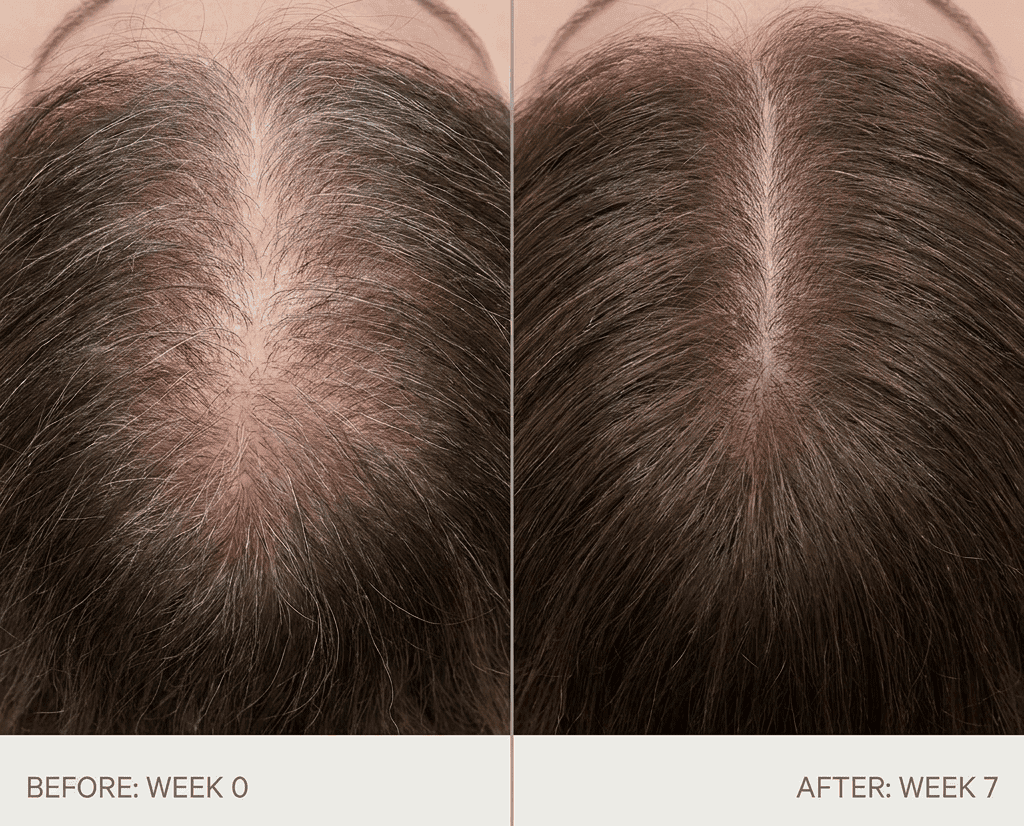
For six years I had been managing Denise's hair loss.
Parting it. Layering it. Selling her the same volumizing products every distributor puts on my shelf.
I wasn't helping her heal. I was helping her hide.
And I had been calling that kindness.
And I made her a promise.
"Denise. Give me six months. Don't buy that wig. I'm going to find out what actually changed. And I won't stop until I do."
That night I went to war with everything I thought I knew.
THE PATTERN HIDING IN 22 YEARS OF APPOINTMENT BOOKS
For the next three months I was obsessed.
I started with what I had. Twenty two years of watching hair.
I pulled out my old appointment books. My client notes. My records.
Without meaning to, I had kept the most honest record of women's hair loss that nobody ever asked for.
And the pattern hit me like a freight train.
I had done the hair of women who were now grandmothers.
Full, thick heads of hair into their seventies and eighties. They never thinned the way their daughters are thinning now.
Then I looked at those same families one generation down.
The daughters. Coming in at 48, 50, 52. Parts widening. Ponytails shrinking. Crowns going see-through.
Same bloodline. Same genes. A completely different outcome.
That is when I knew Denise was right.
This is not simply "aging." Aging did not skip a generation and then come back twice as hard.
Something is different for our generation. And it is doing this earlier, and faster, than it ever did to our mothers.
So I started reading at night. Reddit threads. Hair loss forums. Facebook groups for women over 50.
And I read the same heartbreaking lines my clients said out loud, typed by thousands of strangers.
"I mourn my old hair every single day."
"I avoid bright lights because they expose my scalp."
"My mother never went through this. Why am I?"
Every one of these women had done everything right.
Every one had gone to a doctor. Every one had been tested and told she was fine.
Not one of them had ever been told what was actually attacking her hair.
It took me three months of reading to find it.
And when I did, I was furious that no one in my chair had ever heard the word.
THE HORMONE NOBODY WARNED YOU ABOUT
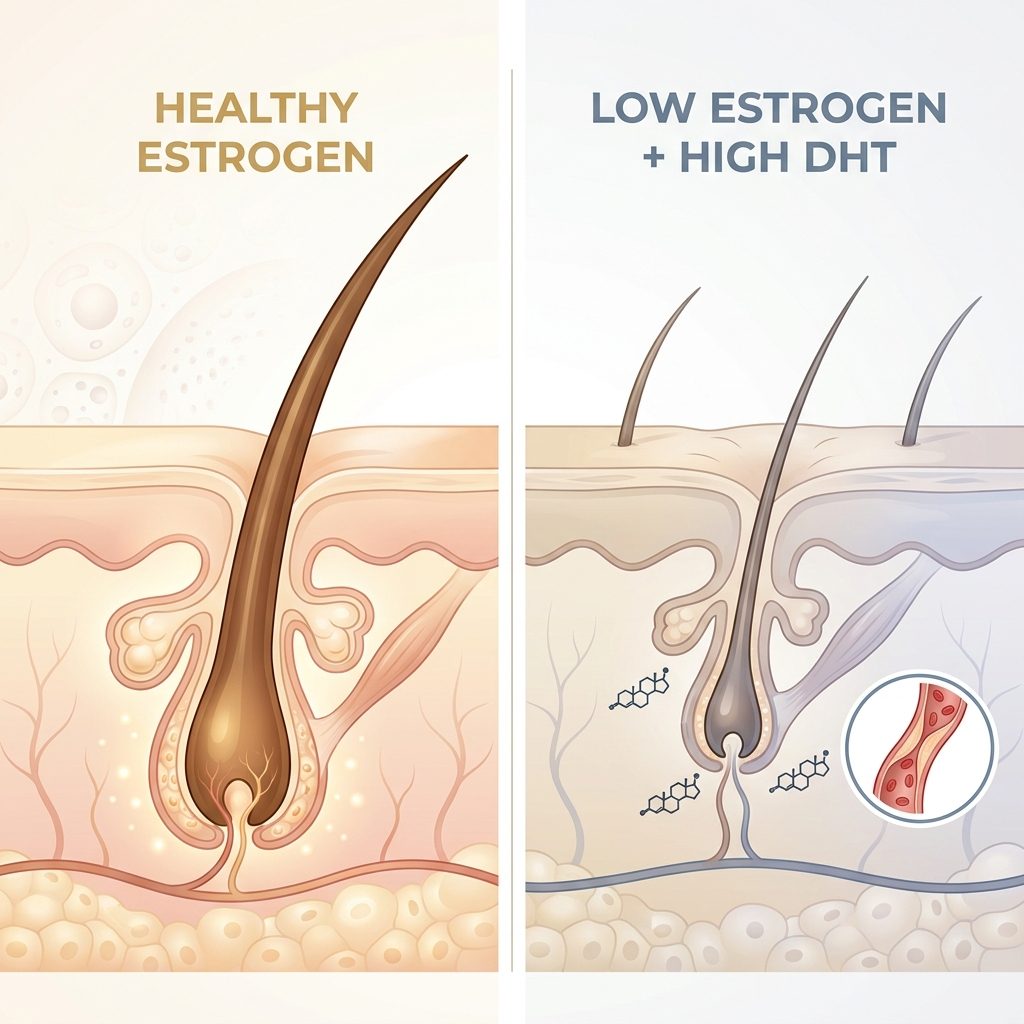
The thing attacking your hair has a name. DHT.
It stands for dihydrotestosterone. It is a hormone your body has always made.
But here is what changes everything after 40.
When you move through menopause, the hormones that protected your hair for your whole life fall away.
And that leaves DHT with the run of the place.
DHT wraps around the root of your hair and slowly chokes off its supply.
Less blood. Fewer nutrients. Less oxygen reaching the follicle.
So every new hair it makes comes in a little thinner than the last. Then thinner. Then barely there.
This is why it feels like your hair is "shrinking." It is.
The follicle is being starved down, one growth cycle at a time.
Now here is the part that answered Denise's question.
Your grandmother had DHT too. But her body was not under the pressure yours is.
Our generation lives under something hers never did.
The relentless stress. The processed food. The chemicals in everything we touch. The way modern life keeps a woman's body in a constant state of hormonal emergency.
Her body produced DHT like a hand resting gently on a garden hose. The water still flowed. Her hair still grew.
Your body, after a lifetime of all this, produces it like a fist squeezing that hose shut.
That is what changed between the generations. That is what no test in your doctor's office was looking for.
But knowing the name of the attacker was only half the answer.
Because here is what I could not understand at first.
Women HAD been told to fight DHT. And they were still losing their hair anyway.
The reason why is the single most important thing in this entire article.
WHY EVERYTHING YOU FOUGHT IT WITH FAILED

Here is what I found. And it is so simple it made me angry.
The DHT is doing its damage down at the root. Below the surface. Deep in the scalp, where the follicle actually lives.
But the outer layer of your scalp is a barrier.
Your body built it to keep things out. Bacteria. Toxins. The weather. It does that job beautifully.
It also keeps out almost every good thing you have ever tried to put in.
Picture watering a tree by pouring the water onto concrete.
You can use the most expensive water in the world. You can switch brands ten times.
The roots underneath stay bone dry. Because the water never gets through the concrete.
That is your scalp. And that is the whole tragedy.
So think about what that means.
The DHT is choking the follicle underneath the barrier. And everything you ever applied to fight it stopped on top of the barrier.
You were bringing the fight to the wrong side of the wall.
Every serum. Every DHT-blocking spray. Every miracle oil.
They sat on the surface, dried up, and never reached the one place the battle was actually being fought.
I am not going to bury you in words about lipid layers until you feel stupid and give up.
Here it is in plain English.
The ingredients were probably never the problem. Where they stopped was the problem.
THE TREATMENTS YOU WERE SOLD — AND WHY EACH ONE LEFT YOU EXACTLY WHERE YOU STARTED
I sat in my empty salon and looked at my shelf.
And for the first time I could explain every single failure. Let me guess what you have tried.
Add it up over a few years and it is five hundred dollars. Or five thousand. Or fifteen thousand.
And you are STILL losing your hair.
Not one of those failed because you didn't try hard enough.
They failed because they either ignored the attacker, or never got through the wall to reach it.
It was never your body. It was never your discipline. It was the delivery.
YOUR FOLLICLES AREN'T DEAD. THEY'VE JUST BEEN CHOKED QUIET.
Here is the part I most want you to sit with.
Because it is the part that made me cry at my own kitchen table.
So many women told me the same terrible fear.
"Maybe I waited too long. Maybe my follicles are already dead."
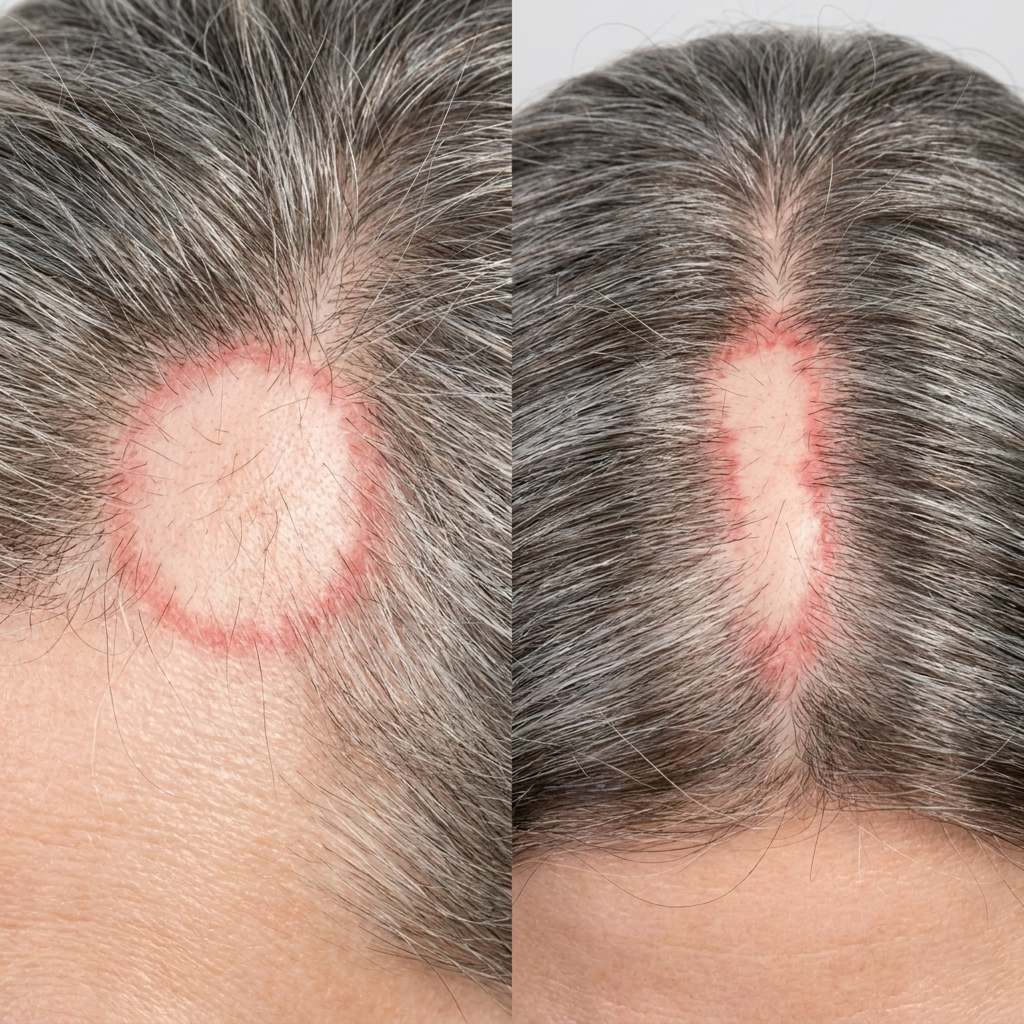
A choked follicle is not a dead one.
A follicle that DHT has been squeezing for years is not gone. It has gone quiet. It has slowed down.
It is making thinner and thinner hairs because it has been starved, not because it is finished.
But I have to be honest with you about the clock.
A follicle under that kind of pressure does not stay patient forever.
The longer the fist keeps squeezing, the quieter it gets. The hairs come in finer. The gaps take longer to fill.
A follicle that is still making a thin wispy hair today is a follicle that still has something to work with.
That is exactly why the woman who starts this month has an easier road than the woman who waits another year.
So the real question was never "is it too late for me."
The real question is the one no doctor and no bottle ever answered.
What if you could finally get help down to the follicle, on the same side of the wall where DHT is doing the damage?
I found the answer to that three feet deep in medical journals at two in the morning.
And it changes everything.
THE ANSWER I FOUND AT 2 A.M.
I stopped reading about ingredients.
Everybody already writes about ingredients. That was the whole trap.
I started reading about skin instead. How things get in. How things get stopped.
And buried in the dermatology research I found the thing that had been staring at me for twenty two years.
Researchers had figured out how to get past the barrier.
Not with a stronger serum. With a path.
If the concrete is the problem, you don't need better water. You need to open the concrete.
They were making tiny temporary channels in the surface of the scalp. Thousands of them. Far too small to see.
There long enough to let the good stuff through. Gone again by the next day.
And when the actives finally rode down through those channels, closer to where the follicle lives and where the DHT does its damage, they behaved like completely different ingredients.
The same actives that did nothing sitting on top started doing something once they got in.
It was never about finding a miracle ingredient.
It was about finally getting the right ones to the fight. I read until the sun came up.
THE FIRST TEST SUBJECT WAS ME

Here is what nobody tells you about being a hairdresser. We get it too.
At 47 my own part was widening. My crown showed through under my own salon lights.
I found my hair on my pillow. In my car. In the sink I cleaned three times a day.
So I built the routine on myself first.
Two minutes. Two or three times a week. That was the whole thing.
Open the channels across my part and my crown. Then work the serum in while the path was still open.
I want to tell you what I braced for, because I know it is the fear sitting in your chest right now.
I have watched women quit good treatments because the first few weeks made things look worse before better.
So I watched my drain like a hawk, waiting for the dreaded shed.
For me it never turned into that. A little more in the comb one week, then it settled.
If you ever see a few extra hairs early on, know it can be the follicle cycling, not the treatment failing.
That is the exact moment most women give up. It is often the moment right before things turn.
Here is what I saw over the weeks that followed.
This was my own experience. Every woman is different, and I will never promise you a calendar.
Around week 2. There was less hair in the drain. I counted the next morning. Still less.
Around week 4. Little upright hairs along my part. Standing straight up like they were brand new.
I took a photo because I did not trust my own eyes.
I even had soft new fringe coming in at my temples, where I had been bare since my early forties.
Around week 8. A client stopped mid appointment. "Marie, did you do something to your hair? It looks incredible."
Around week 12. My part was not screaming at me anymore.
It was just my hair. Healthy. Mine.
THEN I GAVE IT TO DENISE
I brought it to Denise myself.
I told her two minutes, two or three times a week. That was all I would ask of her.
Six weeks later she walked back into my salon.
She was wearing her hair down. Actually down. First time in two years.
"Marie. My husband put his hand in my hair last night. He hasn't done that in so long. I forgot what that even felt like."
She was crying again. Happy tears this time.
She did not say her hair was thicker.
She said her husband touched it. She said she forgot to check her part in the mirror before she left the house.
She got herself back. That was the only measurement that ever mattered to her.
THEN I MADE SURE IT WASN'T A FLUKE
One of my clients proved it without meaning to.
She did the routine for two months. Loved it. Then life got busy and she stopped for a few weeks.
The shedding crept back. She started again. It settled down again.
That is when I stopped worrying I had gotten lucky.
Keep getting help down to the follicle a couple of times a week, and it keeps answering. Walk away, and DHT goes back to squeezing.
Now I know the word "forever" is already in your head. So let me put it plainly.
This is not a pill you are chained to for life. It is two minutes, two or three times a week.
The way you would never skip brushing your teeth and never think twice about it.
A small thing you do to keep something good going. That is very different from being trapped.
THE RESEARCH WAS THERE THE WHOLE TIME
I want to be honest about something.
I did not invent any of this science. I just refused to ignore it like everyone else had.
The delivery research is real.
Dermatologists have long known the outer scalp blocks most of what you put on it, and that opening tiny channels lets active ingredients travel deeper instead of drying on the surface.
Back in 2013, researchers ran a controlled trial adding this channeling step to a standard hair treatment.
The group that got the ingredients delivered deeper grew significantly more hair than the group using the same treatment on the surface alone.
Same ingredients. Different result. The only thing that changed was whether it got in.
And the actives themselves are not exotic.
They are ingredients researchers already respected. They just never had a fair way through.
Acetyl Tetrapeptide-3. In clinical testing it improved hair anchoring strength by 46% and raised hair density by up to 10%, with less shedding after about four months.
Caffeine. In human follicle studies it drove 33 to 46% more hair shaft growth, helped counter the effect of androgens on the follicle, and kept it in its active growing phase longer.
Copper Tripeptide-1. The copper peptide Dr. Loren Pickart discovered decades ago, shown in research to wake up the cells at the base of the follicle and improve the blood supply feeding it.
Read those again and remember one thing.
Those are the results these actives managed while they were still fighting to get through the barrier.
Imagine what they were always capable of on the other side of it, delivered right to where DHT does its damage.
WHY NOBODY BUILT THIS FOR WOMEN LIKE YOU
Here is the part that made me angry enough to do something.
Ask yourself a simple question.
Why do men have a whole aisle of hair loss science, and women got handed a sample of the same foam and a shrug?
Men's hair loss got the research. Got the trials. Got actual prescription drugs aimed at their DHT.
Women's hair loss got called vanity. Got called "just aging." Got called "stress less and come back in six months."
The American Hair Loss Association has said outright that women's hair loss is largely disregarded by the medical world. Millions of women. Disregarded.
You were not imagining being dismissed. You were being dismissed.
So the big players did what pays.
They kept selling you the next bottle instead of solving the one thing that would have made the bottle work: getting it through the wall.
I sold those bottles for twenty years. I am not proud of it.
But I know exactly how the shelf works. And I am done keeping quiet about it.
THIS IS WHAT I BUILT INSTEAD
I partnered with a lab here in the United States and gave them one instruction.
Build this for her. Not adapted from a men's treatment. Not another bottle for the shelf.
Built from the ground up for a woman whose hormones have shifted and whose follicles are under siege.
We called it the Spectra MicroInfusion System.
It is two simple things.
A small device that opens those tiny temporary channels. And a serum built around actives chosen to defend and feed the follicle, made to travel down through those channels toward the root instead of drying on top.
The whole routine takes two minutes. Two or three times a week. That is it.
No dropper you rub in and hope. No pill that gets lost in your whole body.
No grease. No daily chore you have to build your morning around.
HOW IT ACTUALLY WORKS
One. Open the path.
The device creates thousands of microscopic temporary channels across the surface. Far too tiny to see. Not the frightening thing the word needles makes you picture. Just enough of an opening to stop turning your ingredients away.
Two. Deliver the actives.
The serum goes on while the path is open, so the peptides and caffeine ride down toward the follicle, to the same side of the wall where DHT is doing its damage, instead of pooling on the surface and drying.
Three. Let the follicle answer.
A follicle that has been choked quiet is not dead. Feed it and defend it, in the place it actually lives, and it can slowly get back to doing what it always did.
Not a stronger serum. A smarter way in.
"BUT IS IT SAFE TO DO MYSELF?"
I hear this before anyone even lets me finish explaining it.
So let me answer it head on, the way I would if you were sitting in my chair.
This is not a medical procedure. It is not the deep needling a clinic does.
The channels are shallow and temporary and gone again by the next day.
You are not cutting yourself. You are not going to damage the follicles you have left.
Most women feel a light tingle and nothing more.
It was made to be done at home by a regular woman with two minutes and a bathroom mirror.
If you can part your hair and hold a small device against your scalp, you can do this.
REAL WOMEN
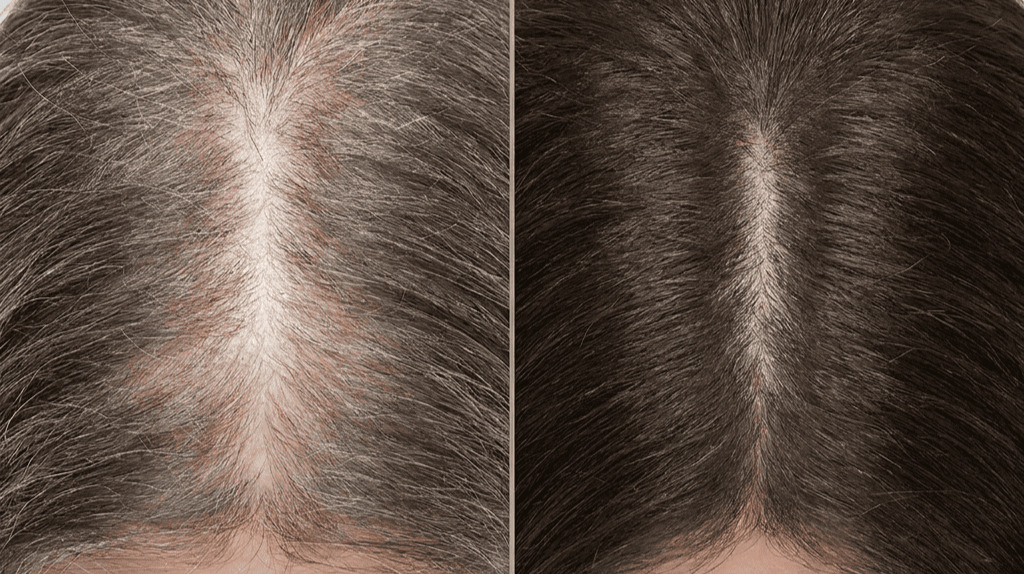
Linda, 54 ★★★★★
"I was pricing wigs online. I mean it. Ten weeks in, my daughter asked if I got extensions. I just cried."
Susan, 61 ★★★★★
"Six months of pills did nothing. A few weeks of this and I have actual baby hairs at my temples I can see in the mirror."
Carol, 58 ★★★★★
"I stopped checking my part in every window I pass. I didn't even notice I'd stopped until my sister pointed it out."
THE OFFER: ONLY $3.45 PER TREATMENT

Think about what "trying everything" already cost you.
The serums. The supplements. The DHT sprays that sat on top. The five hundred, or five thousand, or fifteen thousand you have quietly spent.
Now compare that to two minutes, a couple of times a week, with a system built to do the one thing none of it ever did.
Get through the wall. That is the whole case.
And about the thing I know you are bracing for. I am so tired of the traps in this industry that I refuse to set one.
If there is a refill option, it is there because your serum runs out and you would rather not think about reordering. Not to lock you in.
You can cancel it in a couple of clicks, any time, with no phone call and nobody trained to talk you out of it.
MY 120-DAY GUARANTEE

You have been burned before. I know that better than anyone.
So I am not asking you to trust me. I am asking you to test me.
Use the Spectra MicroInfusion System for 120 days. Two minutes, two or three times a week.
Watch the drain. Watch your part in weekly photos. Feel along your temples for the soft new pieces.
If the woman in the mirror still is not the one you are looking for, email us and say so.
You get every penny back.
No form to hunt for. No "store credit." No twenty minute call with someone trained to talk you out of it.
You email. We refund.
THE TWO PATHS
You are standing at a fork right now.
PATH 1: KEEP GOING AS YOU ARE.
Keep counting hairs in the brush. Keep parting it five ways to hide the crown. Keep dreading the overhead lights. Keep buying the next bottle that stops at the surface while DHT keeps squeezing underneath.
PATH 2: TWO MINUTES, A FEW TIMES A WEEK.
Help delivered to the same side of the wall where the damage happens. A drain that scares you less each week. A part you stop checking. Your hair worn down again. Your husband's hand in it again.
And one ordinary morning, the thing every woman in my chair actually wants.
You leave the house without thinking about your hair at all.
That silence is the whole point. That is what you are really buying.
Not thicker hair. The freedom to stop thinking about it.
WHAT TO DO NEXT
Click the button below. Choose your kit. Enter your shipping. It arrives in a few days.
Then two minutes, two or three times a week. Open the path. Feed the follicle. Let it answer.
Do not close this and tell yourself later.
Later is another shower you dread. Another photo you hide in the back of.
And it is one more season the fist keeps squeezing while your follicles go quieter than they are today.
Your follicles are not dead. They have been choked quiet behind a wall nobody bothered to open. Open it.
🔒 CLAIM MY SPECTRA SYSTEM NOW120-DAY GUARANTEE · FREE SHIPPING · CANCEL ANYTIMETo seeing yourself in the mirror again,
Marie Cutler
Licensed Cosmetologist, 22 Years Behind The Chair
P.S. Denise wears her hair down in her family photos now. She texted me last week. Her husband still hasn't stopped touching it.
That could be you in twelve weeks. But only if you start.
Comments